Nicolas Djeghri studies how marine plankton communities are changing in response to climate change
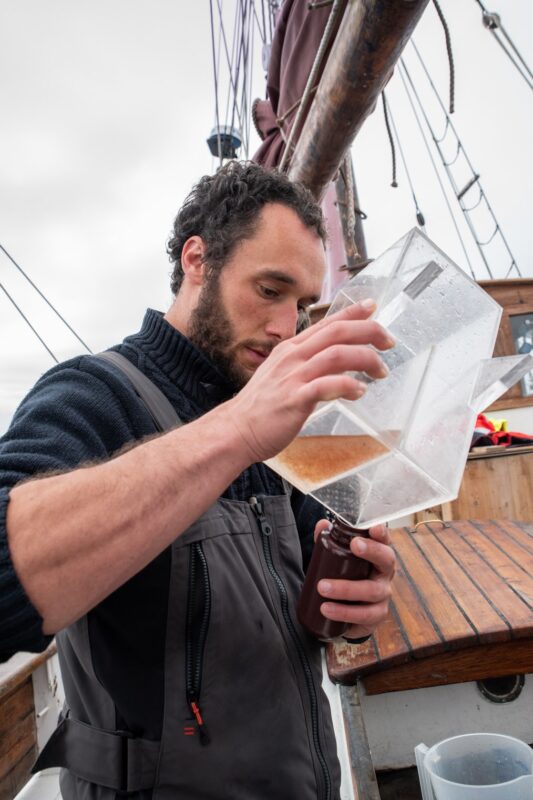
In his research, Nicolas Djeghri focuses on changes in marine plankton communities resulting from climate change, including shifts in their taxonomic and functional composition (traits), as well as their recurring dynamics, particularly seasonality.
Thanks to his two-year ISblue postdoctoral fellowship (2024–2026) at LEMAR, he is focusing in particular on changes in the seasonality of plankton in the North-East Atlantic since 1958, using a statistical method he has developed to better account for seasonality in multidimensional data.
Supervised by Olivier Gauthier (Senior Lecturer, UBO), his project falls under ISblue’s Theme 4, “The Living Ocean and Ecosystem Services“, and is also linked to Theme 1, “Climate Regulation by the Ocean“.
How did you hear about the ISblue postdoctoral call?
Thanks to my contacts at the lab – networking really does make a difference!
What was your journey like before you got to this point?
Quite traditional, but effective:
After completing a Bachelor’s degree in Nantes and a Master’s degree in Marseille, I carried out my PhD at LEMAR in Brest on the trophic ecology of photosymbiotic jellyfish. I then went on to do a postdoc at the Marine Biological Association (MBA), specifically as part of the Continuous Plankton Recorder (CPR) survey in Plymouth, UK, where I trained in community ecology and digital ecology and developed my current research interests. I am now back in Brest for a new postdoc adventure!
What made you want to work in marine science?
I have long been drawn to the sea, its mystique, and the thrill of exploration…
And plankton in particular: these invisible “little monsters” have always fascinated me!
What is your day-to-day life as a researcher like?
R (a programming language for statistics), writing… then more R, and more writing!
These days, I mainly focus on data analysis and developing methodologies.
I don’t do fieldwork or lab work anymore. Fortunately, others are collecting the data! And sometimes, I try to explain my work to my colleagues… without completely losing them along the way.
What is your greatest memory from the field or from your research?
I was lucky enough to spend three weeks sampling in the Norwegian Sea as part of the DRASTIC oceanographic campaign aboard an old sailing ship built in 1914: the Lun II. A timeless experience… and a real adventure!
Find out more about the DRASTIC at-sea campaign.
What is the biggest challenge in your field today?
It’s hard to say. Probably predicting the dynamics of biodiversity.
We’re managing to do so in certain areas, on certain scales… but overall, it remains extremely complex.
Is there a particular achievement you’re especially proud of?
Most recently, it’s probably the statistical method I’ve developed: Cyclical Ecological Trajectory Analysis (CETA). There’s an accompanying R package available to make it easier for others to use. I think it could be useful to a great many researchers, as describing seasonality in complex data is a real headache.
Has there been a failure or a difficulty that really stuck with you?
My previous postdoc was a bit of a struggle, but looking back, it was also what set me on the path that has brought me this far.
Do you have any ideas or plans for life after your postdoc?
To continue with my research and settle down – in other words, sit the competitive exams.
Good news: I’ve already secured a new two-year postdoc position (outside ISblue), which will allow me to continue my research!
And apart from research, what helps you switch off?
Historical European martial arts (FIIIIIIIIGHT!), even though I haven’t been very diligent of late…
Further information
- Nicolas Djeghri’s page
- Nicolas Djeghri’s GitHub
- Web page for the ecotraj model developed by Nicolas Djeghri
 Attention, vous utilisez un navigateur peu sûr !