Days 8 – 10 : Through the plumes
October 2nd – October 4th 2025 | Discovering plumes
Author : Léa
The routine is setting step by step on board: one watch follows another, operations continue, and some visits are organised, like this of the chemistry laboratory. Every day brings its set of discoveries, the campaign continues, and with its, new ways are taking shape.
We took course to the “boîte Côte” (Figure 1), with sites of “Fer à cheval” (shape in U turned to the north) and of the Crown (a series of ridges arranged in a ring just north of the “Fer à Cheval”), located at around 15 km to the east of Petite Terre, where some instruments must be recovered. It is a key zone, which is checked and methodically followed from some years, because significant fluid emissions have been observed here, training in the water column, on several hundred metres, sub-vertical or inclined structures, called plumes. These fluids are in reality carbon dioxid (CO2) in the form of droplets rising from the seabed
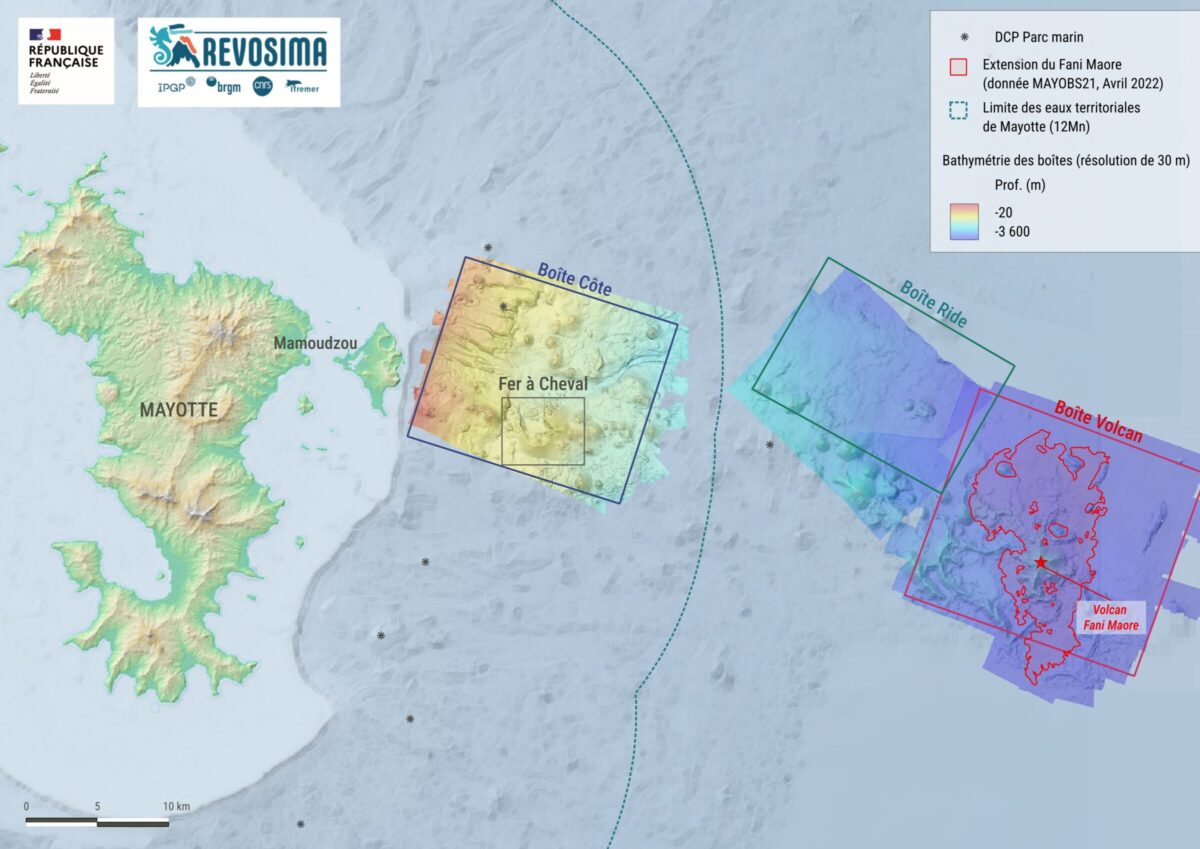
Figure 1 : Location of the study area, with the 3 main boxes on the east of Mayotte. Document from the network REVOSIMA
To situate these plumes and follow their evolution, we always must adapt the planification of the mission and adjust the monitoring in real time. The adaptability, it is the campaign’s keyword: every new data collected, every incident or late may lead to change the initial programme. The communication stays also essential to coordinate efficiently operations between different scientific and technic teams. For this, 2 daily meeting are done, one with every scientist (including students), and the other with the operation managers on the boat, by post and instrument.
As we approach of the plumes’ road, the concentration and the reactivity of the watch team are important to identify plumes already listed and to detect new activities. This area is of the utmost importance: it enables to following the emissions’ evolution over the years. Plumes are detected thanks to the probes SMF and EK80 (Figure 2).
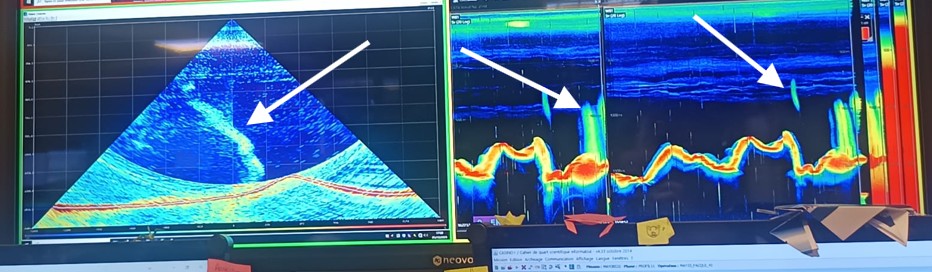
Figure 2. Detection of plumes (arrows), visibles in real time on the EM122 (on the left) and on the EK80 (on the right)’s screens
The atmosphere on bord is electric at the idea to detect an unknown plume! This following is really important, because it provides information about the evolution of the volcanic activity: every variation – whether it be an amplification, a weakening, or a constant of emissions compared to the last years, or also a reorganisation (a division or clustering of the roots of the plumes – constitute an essential indicator (proxy) about the submarine volcano’s evolution.
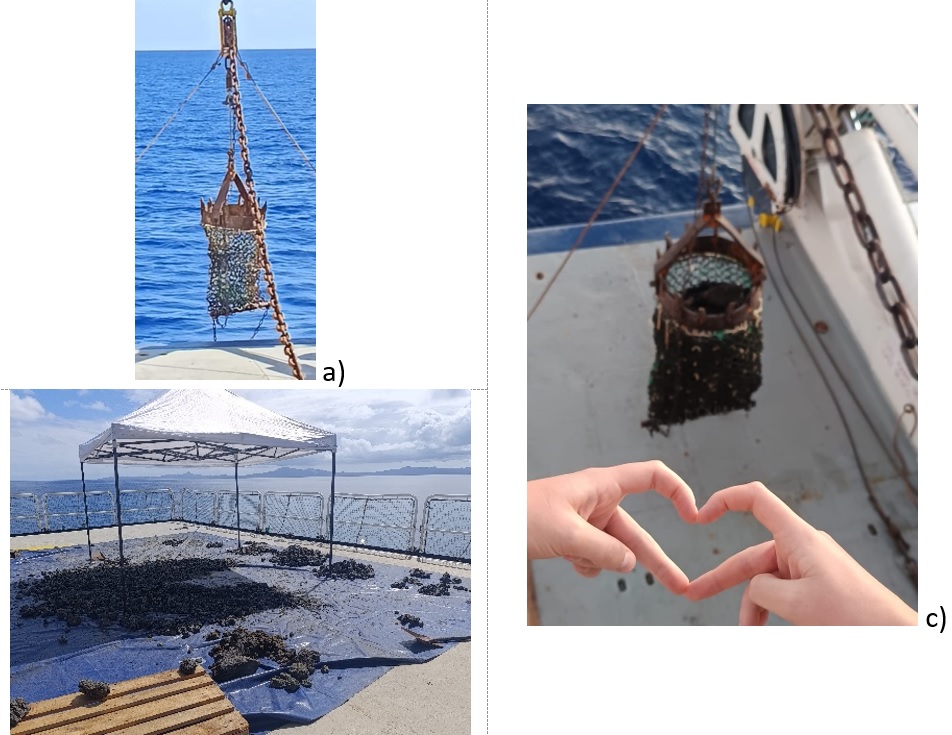
Always on the operation’s side, another important moment of these last days: the realisation of the first weep! This moment was a real frenzy, particularly for the geology students, over-excited at the idea to discover the first samples. Stroke of luck, the operation took place just before the dinner – perfect to enjoy the meal and the success of the operation at the same time.
Figure 3. First weep on board. a) lowering of the dredger; b) classification of the rocks (here, basanites) y the dredging team (credits Jade) ; c) hoisting the dredger with its load (credit Raphaëlle & Léa).
As the mission continues, the fatigue begins to be felt: the wake-up begin more difficult and watches seem long, particularly when the activity slows down. To keep the attention, everyone finds something to doing, enjoys to talk with scientists on board or gets a bit of rest between two operations. Be responsible of the water column’s acoustic required an important vigilance, particularly in areas where plumes are clustered.
The October 1st was a memorable day during the Jacques’ career: à midnight, he officially had took his retire, professor emeritus, whilst remaining on board to guide us with the same kindness. His colleagues back on land are waiting for him with open arms to give him a proper send-off as he retires.
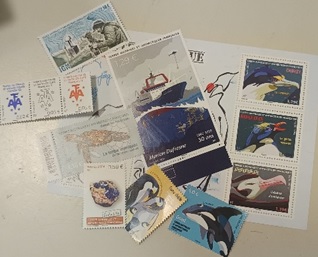
The October 3rd, a stamp’s sale hold the life on board (figure 4). The initiative, a victim of its own success, took the crew by surprise: the last to arrive had very little choice.
Figure 4. Stamps sold on board
The October 4th during the evening, the programm was quickly reviewed: as we had a very short timing, we should adapt us. We had an appointment at 5am on the nprth to Mayotte, at the pass, where the pilot was waiting for us for the next steps.
 Attention, vous utilisez un navigateur peu sûr !