Layla Creac’h is studying neodymium (Nd) isotopes in Southern Ocean sedimentary diatoms
Who are you and where are you from?
My name is Layla Creac’h. I am a geochemist and palaeoceanographer from Brittany, France.
How did you hear about the ISblue postdoctoral call for applications?
Friends and colleagues told me about the ISblue postdoctoral call when I was looking for funding opportunities in France, and more specifically in Brittany.
What is your current research topic?
I am currently interested in neodymium (Nd) isotopes in Southern Ocean sedimentary diatoms. Nd is a palaeoceanographic tracer of ocean circulation, typically measured in foraminifera, which are carbonate microfossils. These foraminifera are relatively scarce in my study area (the Southern Ocean), whereas diatoms (silica-rich microalgae) are extremely abundant! This is therefore the focus of my ISblue research project: extracting the Nd isotopic signal from diatoms in order to develop a new palaeoceanographic tracer.
What was your career path before reaching this point?
I first completed a Bachelor’s degree in Chemistry in Rennes, before specialising in marine chemistry during my Master’s degree at IUEM in Brest. I then moved to Australia (University of Tasmania), where I completed a PhD in Southern Ocean geochemistry and palaeoceanography. I subsequently continued my research in Germany (Heidelberg University) and Switzerland (ETH Zurich), before returning to Brest for my ISblue postdoctoral position.
What inspired you to pursue a career in marine sciences?
During my undergraduate studies, I was already keen to specialise in environmental chemistry. I then completed an internship with the marine chemistry team at the Roscoff Biological Station, which I really enjoyed. My Master’s degree in Marine Sciences, specialising in Marine Environmental Chemistry, further confirmed my passion for this field.
What does a typical day as a researcher look like?
It looks like a very long to-do list! A mix of laboratory experiments, data processing, writing papers, emails and funding applications, as well as seminars and meetings.
What is your best fieldwork or research memory?
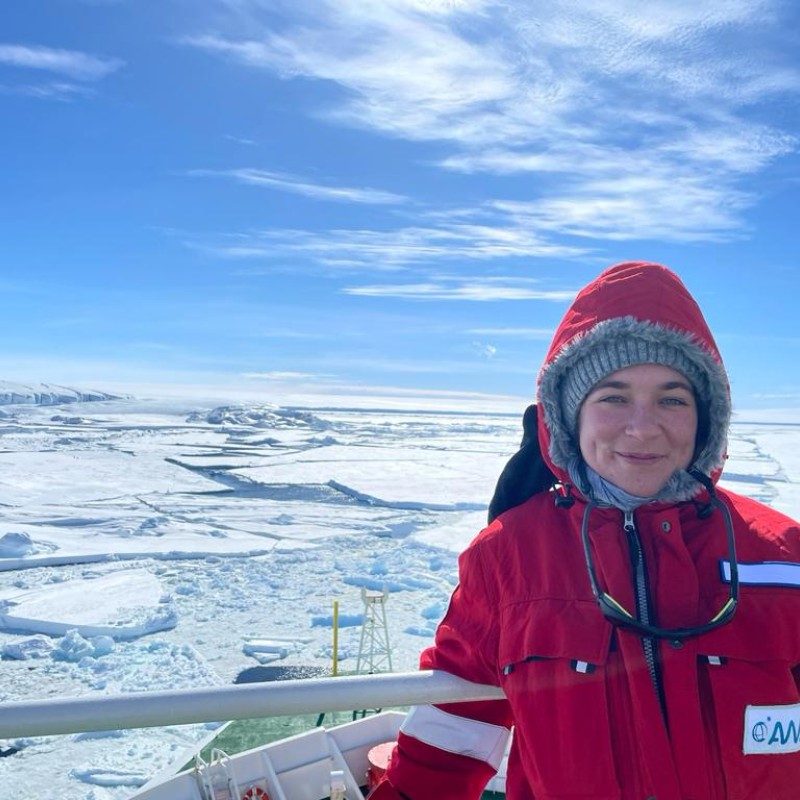
Perhaps seeing my first iceberg during the CANYONS 2023 expedition! It was towards the end of my PhD, after years of working on the Southern Ocean and several expeditions being cancelled due to the COVID-19 pandemic. It was certainly a memorable experience.
Is there an achievement you are particularly proud of?
I spent a lot of time doing science outreach during my PhD, and I particularly enjoyed being part of the “Young Tassie Scientists” programme. Through this programme, I visited dozens of schools across Tasmania, meeting children of all ages and helping them understand the importance of marine sciences.
Has there been a failure or challenge that particularly affected you?
Failures are common in experimental research: inconclusive results, rejected papers or unsuccessful funding applications. The biggest challenge at the moment is the lack of permanent positions in academia.
Do you have any plans or projects for life after your postdoc?
I would like to continue my research in Southern Ocean geochemistry and palaeoceanography and, hopefully, secure a permanent research position in Brest.
Outside research, what helps you switch off?
I enjoy spending time by the sea, scuba diving and being with my loved ones.
Find out more:
 Attention, vous utilisez un navigateur peu sûr !